
Visit HovercraftTraining.com to learn how hovercraft can help you work smarter or play harder, check out our course offerings and sign up to begin your adventure in flight.
Showing posts with label Commercial hovercraft. Show all posts

30 November 2014

Hovercraft: The right vehicle for the job – or not?

Hovercraft pilot training – that comes after you buy a hovercraft, right? Not always. In fact, particularly with commercial hovercraft, it’s often just the opposite. Businesses across the world come to Hovercraft Training Centers to determine if a hovercraft could expand their services and boost their bottom line … and also to protect their bottom line by letting them ‘fly before they buy.’

That’s what brought Ed Savage to HTC. Savage is a Manager at Pella, Iowa-based Vermeer Corporation – a manufacturer of construction, mining, utility, environmental and agricultural equipment.

Savage explained why he took an HTC training course: “I’m part of a research & development team at Vermeer and we’re working with a customer on a project where there needs to be as little surface damage as possible. So we’re trying to find the best vehicle for that, and I’m here to see if a hovercraft is the best way to go. None of us has any experience with hovercraft, so we thought it was best to do the training. Since it only takes a day, it’s worth the time and expense. My goal is to learn how to operate it without destroying something, and to make it successful on this project. It’s going to be a challenge.”

Vermeer’s engineers, along with HTC Senior Instructor/Neoteric Hovercraft President Chris Fitzgerald agreed that the customer’s project would be a challenge for any vehicle, including hovercraft. The project involves traveling over delicate peat bogs in Minnesota, and state and federal regulations mandate that these cannot be damaged or disturbed. Minnesota has more peatlands than any other state except Alaska, and its peat industry adds more than $10 million annually to its economy.

Since Savage said, “There’s a 99 percent we’ll never be on water with the hovercraft,” HTC customized the training to the potential use, as always, and Savage’s flight training was conducted entirely on land …
After a morning of classroom training to learn how hovercraft work,
Ed Savage prepares for hands-on pilot training outside HTC headquarters. 
Via wireless headsets, instructor Chris Fitzgerald provides guidance and feedback
as Ed Savage undergoes an afternoon of flight training.
Although the Indiana terrain at HTC in this next photo may look a bit like a peat bog, the final determination as to whether or not a hovercraft would work for Vermeer Corp. would later be made via flight over actual peatlands in Minnesota …
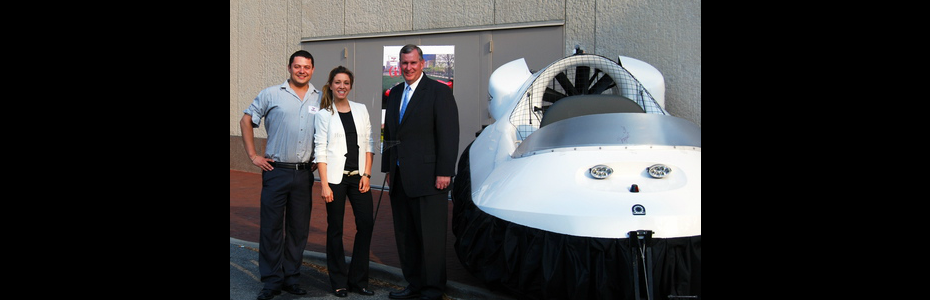
After his day of  training, Ed Savage (right) receives his Hovercraft Pilot Certification
from HTC Senior Instructor Chris Fitzgerald.
Savage described his training course: “It’s a neat feeling to just start floating up like that. It was a little more difficult to catch onto than I thought it would be. You watch videos of hovercraft and think, ‘Oh, that looks simple,’ but then you do it yourself and see that training is definitely a necessity.”

The final result of Vermeer Corporation’s feasibility study? When the hovercraft was tested on the peat bogs in Minnesota, it was decided that the engineers and Chris Fitzgerald were correct – this was a rare instance where the job was not one for a hovercraft.

The bottom line? A hovercraft can be a valuable business asset – or it could turn out to be an unnecessary expenditure. There’s only one sure way to find out …

Fly before you buy:


17 November 2014

HTC Grad Using Hovercraft for Unexploded Ordnance Detection

Hovercraft Training Centers graduate Richard Funk, Senior Geophysicist with Tetra Tech, Inc., will use a customized Neoteric commercial hovercraft for detection of MEC/UXO (Munitions & Explosives of Concern/Unexploded Ordnance) over shallow coral reefs in the Caribbean Sea. And it all began with a training course as a feasibility study at HTC!

Read the full story below, recently published in the Environmental & Engineering Geophysical Society magazine, FastTIMES ...

Tetra Tech MEC/UXO Detection System Deploys via Neoteric Hovercraft

Tetra Tech, Inc., in collaboration with Neoteric Hovercraft, Inc., has produced a new environmentally-sensitive munitions detection system capable of accessing shallow areas where no other watercraft is able to travel and where sensitive habitat is only inches beneath the water’s surface. Tetra Tech’s in-house developed TEMA (Towed Electromagnetic Array) attaches to the company’s customized Neoteric hovercraft to permit MEC/UXO detection in areas previously accessible only by more expensive, less sensitive aircraft-based systems.

Richard Funk, Senior Geophysicist with Tetra Tech’s Marine Mapping Group, describes the TEMA’s unique features: “Unlike a magnetometer, the TEMA is an active sensor that can detect all metals, ferrous and non-ferrous. Its detectors are focused, so they’re not affected by nearby metal structures such as piers, bulkheads and bridges. Data from all devices – multiple high-power EM sensors, altimeters, positioning sensors and video/still cameras – is recorded in real time. The 3-meter swath coverage and the use of high-power EM units increases survey power, with lower operational costs and better detection capabilities.”
In an early prototype development model Neoteric hovercraft, the TEMA system is
tested and evaluated to determine the optimal pivoting and pushing system.
Tetra Tech has researched the use of hovercraft for MEC/UXO survey for many years, particularly for use in difficult areas for data collection, such as shorelines and surf zones. “Our goal is to push it to the next level so we can go where other people can’t go,” Funk says, “A hovercraft takes you places you can’t go with conventional craft, places that are too shallow for a boat, places you can’t walk.”

Tetra Tech selected Neoteric to manufacture their hovercraft because “Neoteric’s HoverTrek™ outmaneuvers other hovercraft on the market, and our projects demand that increased control,” said Funk. “Additionally, Neoteric has decades of experience custom-manufacturing their hovercraft to client specifications, and we were impressed by the company’s mandate that repeated testing be performed throughout the customization of our hovercraft.” The craft’s customizations include mounting points for the TEMA sensor array, mounts for the electronics modules, mounts for the pilot’s display and data collectors’ displays, a table for data collectors, TEMA battery mounts, GPS antenna mounts, and a bimini top.
Tetra Tech’s fully customized Neoteric HoverTrek™ is prepared
for its final over-water testing.
The unusual maneuverability of the Neoteric hovercraft is attained through a patented fly-by-wire reverse thrust system, which makes it the only hovercraft on the market with effective brakes. As Neoteric President Chris Fitzgerald explains, “Our reverse thrust system surpasses jet aircraft in efficiency; while most aircraft deliver an average of 18 percent thrust in reverse, the HoverTrek™ delivers 60 percent. Unlike other hovercraft, the HoverTrek™ can fly backward, spin, and hover over ice and on swift water.”

Tetra Tech will deploy its new hovercraft-based munitions detection system in early 2015 to conduct Phase 2 of an ongoing MEC/UXO remedial investigation and feasibility study at a Defense Environmental Restoration Program (DERP) for Formerly Used Defense sites (FUDS) area in the Caribbean. The site was an impact range for aerial bombs and rockets, missiles, mortars and naval projectiles from 1903 until 1975.

The entire site comprises 1,030 acres; the area to be surveyed with the TEMA-equipped Neoteric hovercraft is more than 200 acres of shallow coral reefs with listed and protected corals. This area was originally excluded from the survey due to the potential for damaging the coral. By using the Neoteric HoverTrek™, which hovers nine inches above the surface of the water, Tetra Tech can now complete the survey with confidence that the coral reefs are in no danger of harm.

The pairing of the TEMA system with the Neoteric hovercraft’s low environmental footprint - less than 1/30th that of a human foot – is an excellent example of how the perfect vehicle for the job can also be the perfect vehicle for the environment, allowing personnel to work safely and efficiently while protecting sensitive habitat.

About Tetra Tech:
Founded in 1966, Tetra Tech is a consulting, engineering, construction management and technical services firm with 14,000 employees and 330 offices worldwide. Based in Pasadena, California, Tetra Tech has decades of experience with MEC/UXO detection and remediation for the U.S. Navy, U.S. Army Corps of Engineers and commercial clients.

About Neoteric Hovercraft, Inc.:
Founded in 1960 and based in Terre Haute, Indiana, Neoteric Hovercraft, Inc. is the world’s original light hovercraft manufacturer. The Neoteric HoverTrek™, the only hovercraft in the industry with effective brakes, is utilized in commercial, rescue, recreational and military operations in more than 50 countries.
www.neoterichovercraft.com


17 March 2014

A wise business move for Wilderness Place Lodge: an HTC Test Flight

Buying a hovercraft can be a smart business move. But a wise businessman doesn’t make impulsive decisions. Instead, he gathers information, researches options and conducts a thorough analysis before he commits to a capital outlay. Cory Wendt of Madison, Wisconsin exemplifies that wisdom – and that’s what brought him to Hovercraft Training Centers.

While in college, Cory and his friend Jason Rockvam of Clancy, Montana, worked as guides at a fishing lodge in Lake Creek, Alaska. It so impressed them that they made a business decision: for the last 13 years they have owned and operated Wilderness Place Lodge - and it’s now one of the top five fishing lodges in Alaska.

The Lodge is located on Lake Creek River, which offers some of the finest spin and fly fishing in Alaska. But it also offers gravel bars, islands, pinched-off oxbow backwaters, shallow waters and other areas boats and other vehicles can’t access. Cory and Jason pride themselves on providing their guests with the best Alaska fishing experience, keeping it up-close-and-personal – and flexible. To add to that flexibility, they decided to add a hovercraft to their fleet of 18-ft. boats. As Cory says, “If one little point is an impasse for our guests, it spoils the trip.”

How about an airboat; wouldn’t that work? Cory says no: “I don’t think airboats are that great. We wouldn’t use one. Our guests wouldn’t come; it would be too loud. They come up to get away from everything and airboats are just deafeningly loud. And airboats are very difficult to control coming downstream. A hovercraft is the practical tool to get us from point A to point B.” 

So Cory conducted his due diligence and made another wise business decision: he came to HTC for Test Flights on a 4-passenger and a 6-passenger Neoteric hovercraft …

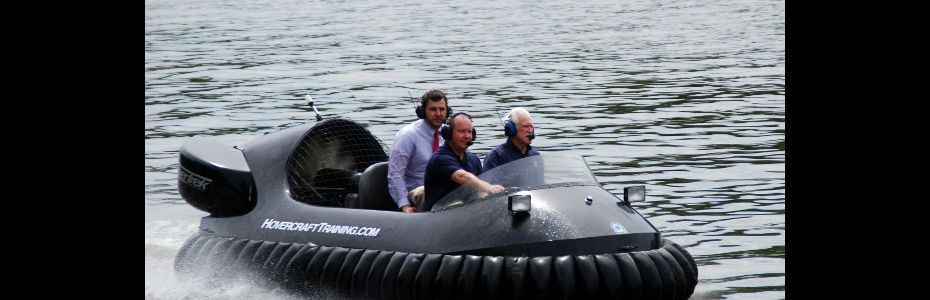
Cory (center) and his father Bob Wendt (right) board a 4-passenger craft for a flight on the Wabash River with HTC instructor Steve Stafford (left) …

And off they go - to join a second HTC Test Flight also in progress ...

Before smoothly landing the craft onto the boat ramp, Steve gives a final demo of the unusual maneuverability of the Neoteric HoverTrek™ due to its patented reverse thrust system. (And no, he didn't lose a passenger on the river! The two Test Flights in progress switched passengers so they could fly on both the 4- and 6-passenger craft) …

But an HTC Test Flight isn’t just ‘take a quick spin and go home’ – we spend time with you to help you make the right decision. Here, Cory and Chris Fitzgerald, HTC Senior Instructor and Neoteric President, thoroughly go over Google Earth views of Lake Creek River to discuss which hovercraft model would best meet his needs …

After two HTC Test Flights, during which Cory had the chance to take the controls, he was impressed with the flexibility of the hovercraft. “It was smoother than expected. I didn’t expect it to be able to go through all the mud and sticks. I figured all those sticks would break up the air flow, but they didn’t.”

And Cory immediately understood the importance of proper training. “I didn’t fully have an appreciation until I drove it; it started to feel a lot more like an aircraft. I could understand why training is important – I’d read it and heard it but didn’t really appreciate it until I was at the controls.”

What would he say to someone who wants to buy a hovercraft and just take off in it with no training? “DON’T. At the Lodge, we require our boat captains to practice ten 8- to 10-hour days before they carry passengers. Training is a must.” And he added, “We’re also the first responders, and I don’t want to have to respond to an accident that we caused.”

So, whether Cory decides on a 4- passenger or a 6-passenger hovercraft for Wilderness Place Lodge, he definitely intends to undergo an HTC training course when he picks up his new craft – another very wise business decision!


Read more about Wilderness Place Lodge …
  and
Experience your own HTC Test Flight …


27 February 2014

Tetra Tech tests hovercraft for ordnance removal project

Sometimes a commercial hovercraft is the only vehicle that can get the job done. There’s a sure way to discover if that’s the case for your company: follow Tetra Tech’s lead and take a training course at HTC to experience hands-on what a hovercraft can do for you. It’s the logical first step.

Based in California, Tetra Tech is a global consulting, engineering and construction firm with 330 offices worldwide. Tetra Tech also provides disaster management and Homeland Security services; it has responded to more than 2,000 chemical, biological, radiological, nuclear and explosive events, as well as natural catastrophes such as hurricanes, earthquakes, floods and tornados.

Tetra Tech personnel David Bennett, an ordnance removal specialist, and Richard Funk, a geophysicist, traveled to HTC headquarters to undergo a Training Course and test the capabilities of a hovercraft …

From left: HTC Flight Instructor Steve Stafford; Richard Funk; HTC Senior Flight Instructor
Chris Fitzgerald; and David Bennett.

Tetra Tech has a military contract to conduct an ordnance removal project in Puerto Rico that will involve transporting equipment over coral reefs. Boats are typically used to carry the equipment, but boats can damage the coral. Hovercraft, however, will enable them to fly 9 inches above the surface of the water, pushing or pulling the equipment on a raft - working safely and efficiently while protecting the coral reefs.

As Bennett explains, “A hovercraft is for going places you can’t go with conventional craft, places that are too shallow for a boat, places you can’t walk. I develop systems for detecting munitions. We try to push it to the next level so we can go places other people can’t go.”

Their day of training definitely ‘pushed it to the next level’ – at the training site, the Wabash River was encrusted with flowing broken ice …


But HTC's Neoteric training hovercraft mastered these extreme conditions with ease, sailing across moving ice chunks and debris like no other vehicle could possibly do ...


After challenging day of training, David and Richard felt even more strongly that hovercraft were up to the tasks facing Tetra Tech. They’re now working with Neoteric who will custom-design their craft with special accessories to meet their needs.

See a complete photo gallery of the day's training session on Facebook.


Learn more about Commercial Hovercraft Pilot Training ...

Learn more about Tetra Tech ...


26 November 2013

Heads up, Florida! WaveRunners aren’t the only game in town

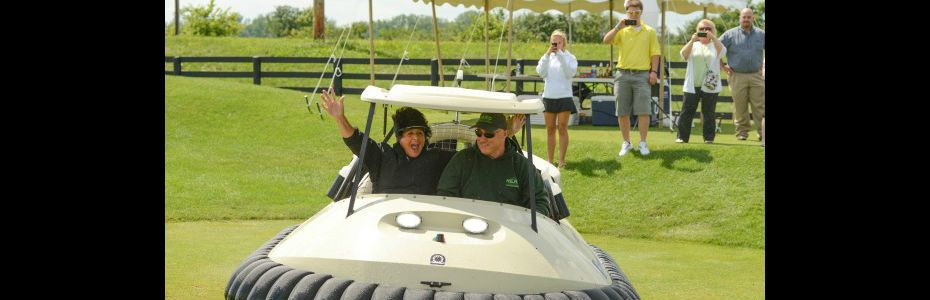
Even though Ryan Peacock, a recent HTC trainee, says that for the last 25 years he “pretty much eats, drinks and sleeps watersports”, he knew couldn’t just jump in a hovercraft and take off. In looking for something a bit different for his business - All Florida Watersports on Marco Island - Ryan says, “We started looking on the web, and there you guys were – something to do other than WaveRunners and typical boat rentals.”

He ordered a six-passenger commercial hovercraft from Neoteric, then immediately signed up for training at Hovercraft Training Centers, recognizing that the “first step is to know what a hovercraft does and how it operates.”
Ryan Peacock (second from left), and his coworkers complete HTC training with instructor Steve Stafford (third from left).
Ryan’s 6-passenger Neoteric Hovertrek™ at home on Marco Island, Florida.
Before his hands-on flight training, Ryan and his team said they read the HTC Training Manual and the phrase that stuck in their minds was, “It’ll take your ego away.” And after training, when asked if they learned anything about hovercraft that they didn’t know before, their joint response was, “Yes – most of it! It’s wild, for sure!”

What impressed them most? “For us, being boat handlers, the ease of handling the hovercraft. It’s a different animal altogether. It’s just incredible how there’s no transition; from land to water you don’t feel a thing. It’s amazing!”

Finally, the All Florida Watersports crew offered some wise advice: “You can’t do it without training; it would be near impossible without an instructor. You have to have the experience of an instructor talking continuously in your ear to accomplish your maneuvers.”

That’s why HTC is here – and we're confident that Ryan and his professionally trained team are hovering on a real business boost for All Florida Watersports!


26 September 2013

James Walker: HTC-trained Commercial Hovercraft Pilot

Hovercraft are not just for recreation – hovercraft also mean business. Just ask James Walker, an amphibious vehicles operator for Great Lakes Dredge & Dock Co., of Oak Brook, Illinois. GLDD is the largest provider of dredging services in the U.S. and one of the growing number of companies in the world who provide critical services with commercial hovercraft.

After James (center) and his crew learned to fly and maintain the GLDD hovercraft at HTC, he said, “It’s flying; it’s not a boat, it’s not a jet ski. Hovercraft are unique and you get a much better perspective in knowing what you’re dealing with when you know it from the ground up.”

James’ training quickly proved its worth in a major environmental restoration project on Pelican Island, a key barrier island off the coast of Louisiana. Pelican Island is crucial for protecting Louisiana people and property against storm surges and is one of America’s richest fisheries – but it has one of the highest rates of wetlands loss in the world.

As Louisiana Congressman Cedric Richmond explains, “If one block of New York City disappeared every hour, the nation would be outraged. Well, Louisiana loses a football field of wetlands every hour, which is crippling to the state and the nation. It affects our seafood supply, gas and oil reserves, and storm protection. Reversing this trend is a critical national priority.”

… and you’ll never again think of hovercraft as just toys.