
Visit HovercraftTraining.com to learn how hovercraft can help you work smarter or play harder, check out our course offerings and sign up to begin your adventure in flight.
Showing posts with label Pilot training. Show all posts

15 December 2014

Hovercraft Operation: A Three-Legged Stool

We at Hovercraft Training Centers use the analogy of hovercraft operation as a three-legged stool: If one leg is weak, it topples. The three legs are: 1) A properly engineered hovercraft; 2) Thorough pilot training; and 3) A comprehensive maintenance program.

When you simply buy a hovercraft and take off on your own without pilot or maintenance training, most likely it’s going to end up parked in your garage and, whether you planned to use it for business or pleasure, your dream is going to topple.

But when you make sure your intentions have a strong foundation, your future with your hovercraft will play out like Barry Eison’s – its novelty and usefulness will increase over time. Barry is a 58-year-old mechanical engineer from Tennessee, who bought a hovercraft a year ago, but first underwent training at HTC.

Barry Eison (right) receives his Hovercraft Pilot Certification from HTC Senior Instructor Chris Fizgerald.
Barry keeps a journal of his hovercrafting and often sends us excerpts, so we’ll let him tell his story in his own words …

January 2014:
“I bought a hovercraft because every time we go out hunting, fishing, exploring, we see places we can’t get to. So many areas are inaccessible. Duck hunting is big in my area and one of the biggest frustrations for duck hunters is you have to be able to go from water to land to water – a hovercraft makes that possible. I’ve been looking at hovercraft for five years. I’ve looked at every hovercraft company out there … Neoteric is the only one that doesn’t have a single negative review.”

February 2014: (after his HTC training course)
“My biggest concern was being able to safely operate the craft. Here’s what I learned:
1) Training is absolutely necessary. If you don’t know how to use it, stay off of it!”
2) A hovercraft is a flying machine. Its capabilities must be learned and it takes time to learn to operate it.
3) If one gets too “cocky” or arrogant in their familiarization with the craft, you can get hurt of damage the machine.
4) It’s important to learn to feel the response of the craft and recognize that it doesn’t take much to alter its flight.
5) Anticipate the path you will take when you’re executing turns or other maneuvers.
6) Think, think, think! Starting, stopping – every move requires thought until you know it by heart.
7) Don’t overreact when responding to changes.
8) Learn the machine – inside and out, front to back.”

August 27, 2014:
“I love this machine. The more I use it, the more I realize the engineering and research & development that went into its development. Well done, Neoteric, well done. I am becoming quite confident with it and absolutely cannot wait to get it out hunting this winter. It has already opened up areas that I have hunted my entire life but have never been able to access.”

November 12, 2014:
“The hovercraft has performed very well on the Mississippi River and in and around the barge traffic we encounter. I was able to harvest my first deer from an area that I was previously unable to access but can now using the hovercraft. The state game wardens think it is fascinating and have given me the green light to use it freely on land or water within their motorized vehicle guidelines.”

December 15, 2014:
“I took the hovercraft out on the Mississippi River on Friday afternoon and deliberately targeted rough waters (barge wakes, small whirlpools, traversing small rapids over rock dikes, swift current) and the craft performed absolutely flawlessly. The more I use it the more impressed with it I am. You may want to pass this on to other clients: Do not take the training manual home and set it on a shelf. Print it, put it in a notebook and READ IT. Everything you need to know about the craft is enclosed! It has been a godsend for me.”


Thinking you might like to own a hovercraft?
The first step to building a strong foundation is to see if a hovercraft is right for you.


12 December 2014

VIDEO: Hovercraft Pilot Training in Vietnam

Early this year, Hovercraft Training Centers' Senior Instructor Chris Fitzgerald traveled to Hanoi to train first responders from Vietnam's National Department of Rescue & Relief, as well as personnel from Tuyet Nga Co. Ltd., a security and rescue equipment supplier. Tuyet Nga purchased two Neoteric rescue hovercraft for use by the National Department of Rescue & Relief - a great asset in a nation so often plagued by monsoons and floods.

In this recent video, you can see the value of being trained by HTC to train other hovercraft pilots. Here, the HTC-trained pilots are conducting flight training in Vietnam for first responders from Brigade 249 of the Public Affairs Command, who will use the hovercraft for search & rescue and military operations ...


Join the global ranks of HTC-trained hovercraft pilots ...

21 November 2014

An Uncommonly Practical but Fun Holiday Gift: Hovercraft Flight

No matter what your occupation, it’s that time of year when you start thinking about the holidays, and about what gifts you’d like to give – or receive! Recently Clay Russell of Richmond, Kentucky, gave himself an uncommonly practical gift that you might want to give someone on your Christmas shopping list – or add to your own “wish list”.

Clay owns a security systems company in Richmond, and has been a volunteer first responder for most of his life. “I joined the fire department when I was just 15 years old, and started driving the truck when I was 21,” he said. “I got out of firefighting some time ago, but I still volunteer with the rescue squad. I’m a little older now, and not as active as I’d like to be. I pretty much work all the time, trying to build up that retirement fund, so I don't have a lot of hobbies.”

Sound familiar? Maybe, like Clay, you or someone on your holiday shopping list needs a break! He decided to mix business with pleasure by taking a Flight Training Course at Hovercraft Training Centers. “I haven’t really had a vacation in a long time by myself, and I needed a diversion,” he laughed. “I guess that’s a big reason I’m here today. But all my diversions have some sort of either business or altruistic motives; I can’t just go recreate by myself. I needed a reason, so I picked this.”
Clay Russell (left) receives his Hovercraft Pilot Certification from HTC Senior Flight Instructor Chris Fitzgerald.
Everyone would agree that learning to fly a hovercraft is fun, but how do business and altruism fit into Clay’s motives? “What I need to do today is become as familiar as I can with a hovercraft and take this information back to my department – and to my family – and then convince them to either purchase one or help me purchase one,” he explained. “If we buy a hovercraft, I would own it personally and my department could use it for rescue purposes. After a few years, when I retire, maybe I’ll take it to Florida and start a tourism business, I don’t know. Hopefully I can retire with it and have fun!”

Clay describes why his department needs a hovercraft: “The lakes in our area partially freeze over in the winter, then people walk out onto the ice and, of course, they end up needing to be rescued. And in the summer, we have some swiftwater in the area. The Kentucky River, albeit not swiftwater, has dams, so there’s also choppy water we deal with. We normally use a Zodiac for rescue, but it’s very hard to operate. We need something that will stay stationary in moving water.”

And a hovercraft comes naturally to his family’s outdoor lifestyle. “I do rock climb and hike a little bit, with my 8-year-old daughter. My whole family’s kind of outdoorsy,” Clay said. “And not only is a hovercraft an outdoor vehicle, it’s more technical. As a kind of amateur mechanical engineer, it’s very interesting to see how they work. And they’re not common; I’m into the uncommon things in life.”

Clay also came to Hovercraft Training Centers because we train exclusively on Neoteric hovercraft. “I’ve known about hovercraft for years, and I’ve researched every brand out there. I was most impressed by the Neoteric HoverTrek's reverse thrust. So that’s another reason why I’m here.”
With Senior Flight Instructor Chris Fitzgerald providing guidance,
Clay Russell experiences the thrill of flying a hovercraft for the first time.
Who in your life needs a break? Maybe someone who has considered a hovercraft for work or play and would love to do a feasibility study that’s actually fun? (If this describes you, start hinting now!) Shirts and ties have their place, but there’s no better stocking stuffer than the gift of hovercraft flight. And it lets you completely avoid the Black Friday rush!

The most unique holiday gift you can give – or receive … 


19 November 2014

Self-taught Rescue Hovercraft Pilot Takes Flight Training Course

Did you know that temperatures were below freezing this week in 50 U.S. states? At Hovercraft Training Centers, we train in all weather conditions but - especially if you live on the East Coast and are buried in snow - this seems like a good time for you to enjoy some photos of flight training in warm sunshine!

HTC is not only an all-weather hovercraft flight school, we’re also an all-levels-of-experience training center - we train pilots who have been flying hovercraft for years. Scott Hanseth, a first responder with George Larson Marine Rescue in Conway, Washington, has been flying rescue hovercraft for a couple of decades. Yet, shortly before we were hit with an early winter, Scott came to HTC to take a pilot training course. He explains why:

“We’ve been running SCAT hovercraft for 15 to 20 years. We trained ourselves. Some guys pick it up and some guys drive it and say, ‘Not for me.’ It took me awhile to learn how to get comfortable. I want to learn new techniques I can take back to my guys and train them. And I’m interested in learning more about maintenance,” Scott said.
Scott Hanseth (left) receives his Hovercraft Pilot Certification from HTC Senior Flight Instructor Chris Fitzgerald.
Last year, George Larson Marine Rescue bought a Neoteric rescue hovercraft for Scott to operate, so he was pleased that HTC trains exclusively on the Neoteric HoverTrek™. “I got tired of dealing with old worn-out machines. We had an opportunity to buy our own, so I researched different brands for a long time and decided on Neoteric,” he said, “When our interstate bridge collapsed, I got to see Snohomish County’s Neoteric craft in operation. Its maneuverability sold me on it.”

George Larson Marine Rescue’s Neoteric Rescue HoverTrek™
Scott described why maneuverability is an important feature. “We rescue a lot of duck hunters. We take care of the lower Skagit River where it hits saltwater. The tide fluctuates 8 to 12 feet a day, twice a day, so duck hunters get lost or the tide goes out and they can’t get back in, so we go get them.”

Although it didn’t exactly simulate a 12-foot tidal fluctuation, the Wabash River was flooded on the day that Scott underwent his HTC flight training …

And, as always, part of Scott’s pilot training included maneuvering the hovercraft in and out of places other vehicles have difficulty reaching …

As an experienced rescue hovercraft pilot, did Scott Hanseth learn anything new during his training course? “It was great - I learned a lot!” he said. “I had training a long time ago, but it wasn’t as structured like this was. There’s a quote in your Training Manual about a hovercraft being like a bar of soap with a motor on it … that’s true. If somebody starts flying without training, they’re likely to have a bad experience. Get some training, have a professional teach you. Don’t just wing it.”

Scott’s training course also reaffirmed his department’s decision to buy a Neoteric hovercraft. “The Neoteric handles completely differently than the SCAT. In the SCAT, you always have to shift your weight to keep it level and you have to lean to turn. With the Neoteric’s reverse thrust buckets, you just sit there. And on a SCAT, if you go around a corner the outside edge would just automatically go down. They would plow in, religiously, and I’ve seen guys crash into things with them. With the Neoteric, you don’t have to worry about it, and that’s the big difference. It’s a lot more stable.”

An email from Scott just a few days ago confirmed even more strongly that George Larson Marine Rescue’s decisions about pilot training and hovercraft brand were the right ones. He wrote …

“We used our new hovercraft on its first real incident last night and I was extremely pleased with how it performed. We had to go get two hunters that were stranded in Skagit Bay when the tide went out on them. It was dark, 26 degrees, and the hovercraft operated perfectly. There were no issues with the engine in the freezing conditions and the lights, especially the two we added to the fan shroud, were fantastic. The hovercraft was able to handle myself and the two hunters without trouble. Without a doubt, the Neoteric hovercraft is far superior to the SCAT hovercraft we have run in the past.


First responders: Don't just wing it ...
See how a Hovercraft Pilot Training Course could help you save lives.


18 November 2014

Buy a hovercraft without training first? “Bad idea!” says airline pilot.

Bill Holzgrove knows a thing or two about flying – he was an airline pilot for 30 years. And he grew up with airplanes. “My dad was a crop duster, so I knew about airplanes,” he explained, “But I wanted nothing to do with them until I was about 25-26 years old. Then I discovered flying on my own, and I got into it, hook, line and sinker!”

When Bill came to Hovercraft Training Centers in August, the closest he’d come to flying a hovercraft was watching YouTube videos. Why did he choose HTC? A big reason was that we train exclusively on Neoteric hovercraft. “I’ve watched so many videos and I’ve been researching for several months, so I’ve done my homework,” he said. “I checked other companies, other products, but I kept going back to the Neoteric craft - the reverse thrust buckets, that makes the difference.”
Bill Holzgrove (left) accepts his Hovercraft Pilot Certification
from HTC Senior Flight Instructor Chris Fitzgerald.
And why would a former airline pilot want a hovercraft? “I have the best job in the world – I’m retired, so every day is Saturday!” he said, “Originally I was considering an airboat, but it’s too tall for the bridges on the river where I live, but a hovercraft isn’t as tall, so it’ll go under them with no problem. And I live in Minnesota, so there are lakes everywhere.”

A hovercraft will also give Bill year-round access to Minnesota’s waterways; he said the primary surface he’ll be hovering on will be ice. “In the spring and fall, when the water’s going through the transition, I’ll be the only guy out there. And then there’s the winter time on the lakes – looking forward to that!”

Bill launched on his training day with great enthusiasm. “I want to leave here with a captain rating!” he said. “I want to see what a hovercraft can do. As opposed to leaving here knowing what little bit is possible, I expect you guys to show me envelope to see all I can do!”

With Senior Flight Instructor Chris Fitzgerald in the pilot’s seat, Bill Holzgrove
begins his pilot training session – and his first flight in a hovercraft.
Former airline pilot Bill Holzgrove flies a hovercraft for the first time,
with HTC Instructor Chris Fitzgerald providing guidance and feedback.
Bill finished his training day with even more enthusiasm. “It was great! I learned a lot, stumbled a lot, learned from mistakes. That’s part of the learning process: do something wrong, then see what’s right. Every time Chris grabbed the controls, the craft just went where he wanted it to go, then I stumbled through my attempts at it. We went to places I never would have attempted on day one!”

Then the airline pilot in him added, “It’s a matter of experience. I’m guessing Chris would be unable to land a DC-10 with 305 people on board in a thunderstorm without being able to see the runway!”

At the end of the day, Bill decided a hovercraft was just what he needed. He even decided to assemble it himself, from a Neoteric Partially-Assembled Hovercraft Kit. Here it is, nearing completion at the Neoteric factory …

After this experienced airline pilot spent a day at HTC learning to fly a hovercraft, what were Bill Holzgrove's words of advice to someone who wants to buy a hovercraft without undergoing training first? “Bad idea!” he said, “Even if you have some flying background.”


Experience what you can do with a hovercraft ...

17 November 2014

HTC Grad Using Hovercraft for Unexploded Ordnance Detection

Hovercraft Training Centers graduate Richard Funk, Senior Geophysicist with Tetra Tech, Inc., will use a customized Neoteric commercial hovercraft for detection of MEC/UXO (Munitions & Explosives of Concern/Unexploded Ordnance) over shallow coral reefs in the Caribbean Sea. And it all began with a training course as a feasibility study at HTC!

Read the full story below, recently published in the Environmental & Engineering Geophysical Society magazine, FastTIMES ...

Tetra Tech MEC/UXO Detection System Deploys via Neoteric Hovercraft

Tetra Tech, Inc., in collaboration with Neoteric Hovercraft, Inc., has produced a new environmentally-sensitive munitions detection system capable of accessing shallow areas where no other watercraft is able to travel and where sensitive habitat is only inches beneath the water’s surface. Tetra Tech’s in-house developed TEMA (Towed Electromagnetic Array) attaches to the company’s customized Neoteric hovercraft to permit MEC/UXO detection in areas previously accessible only by more expensive, less sensitive aircraft-based systems.

Richard Funk, Senior Geophysicist with Tetra Tech’s Marine Mapping Group, describes the TEMA’s unique features: “Unlike a magnetometer, the TEMA is an active sensor that can detect all metals, ferrous and non-ferrous. Its detectors are focused, so they’re not affected by nearby metal structures such as piers, bulkheads and bridges. Data from all devices – multiple high-power EM sensors, altimeters, positioning sensors and video/still cameras – is recorded in real time. The 3-meter swath coverage and the use of high-power EM units increases survey power, with lower operational costs and better detection capabilities.”
In an early prototype development model Neoteric hovercraft, the TEMA system is
tested and evaluated to determine the optimal pivoting and pushing system.
Tetra Tech has researched the use of hovercraft for MEC/UXO survey for many years, particularly for use in difficult areas for data collection, such as shorelines and surf zones. “Our goal is to push it to the next level so we can go where other people can’t go,” Funk says, “A hovercraft takes you places you can’t go with conventional craft, places that are too shallow for a boat, places you can’t walk.”

Tetra Tech selected Neoteric to manufacture their hovercraft because “Neoteric’s HoverTrek™ outmaneuvers other hovercraft on the market, and our projects demand that increased control,” said Funk. “Additionally, Neoteric has decades of experience custom-manufacturing their hovercraft to client specifications, and we were impressed by the company’s mandate that repeated testing be performed throughout the customization of our hovercraft.” The craft’s customizations include mounting points for the TEMA sensor array, mounts for the electronics modules, mounts for the pilot’s display and data collectors’ displays, a table for data collectors, TEMA battery mounts, GPS antenna mounts, and a bimini top.
Tetra Tech’s fully customized Neoteric HoverTrek™ is prepared
for its final over-water testing.
The unusual maneuverability of the Neoteric hovercraft is attained through a patented fly-by-wire reverse thrust system, which makes it the only hovercraft on the market with effective brakes. As Neoteric President Chris Fitzgerald explains, “Our reverse thrust system surpasses jet aircraft in efficiency; while most aircraft deliver an average of 18 percent thrust in reverse, the HoverTrek™ delivers 60 percent. Unlike other hovercraft, the HoverTrek™ can fly backward, spin, and hover over ice and on swift water.”

Tetra Tech will deploy its new hovercraft-based munitions detection system in early 2015 to conduct Phase 2 of an ongoing MEC/UXO remedial investigation and feasibility study at a Defense Environmental Restoration Program (DERP) for Formerly Used Defense sites (FUDS) area in the Caribbean. The site was an impact range for aerial bombs and rockets, missiles, mortars and naval projectiles from 1903 until 1975.

The entire site comprises 1,030 acres; the area to be surveyed with the TEMA-equipped Neoteric hovercraft is more than 200 acres of shallow coral reefs with listed and protected corals. This area was originally excluded from the survey due to the potential for damaging the coral. By using the Neoteric HoverTrek™, which hovers nine inches above the surface of the water, Tetra Tech can now complete the survey with confidence that the coral reefs are in no danger of harm.

The pairing of the TEMA system with the Neoteric hovercraft’s low environmental footprint - less than 1/30th that of a human foot – is an excellent example of how the perfect vehicle for the job can also be the perfect vehicle for the environment, allowing personnel to work safely and efficiently while protecting sensitive habitat.

About Tetra Tech:
Founded in 1966, Tetra Tech is a consulting, engineering, construction management and technical services firm with 14,000 employees and 330 offices worldwide. Based in Pasadena, California, Tetra Tech has decades of experience with MEC/UXO detection and remediation for the U.S. Navy, U.S. Army Corps of Engineers and commercial clients.

About Neoteric Hovercraft, Inc.:
Founded in 1960 and based in Terre Haute, Indiana, Neoteric Hovercraft, Inc. is the world’s original light hovercraft manufacturer. The Neoteric HoverTrek™, the only hovercraft in the industry with effective brakes, is utilized in commercial, rescue, recreational and military operations in more than 50 countries.
www.neoterichovercraft.com


08 November 2014

Albuquerque Police Officer Learns to Train Hovercraft Pilots

Even though police officer Andy Montoya has been flying the Albuquerque, New Mexico Police Department’s Neoteric hovercraft for 12 years, he recently enrolled in a week-long Master Training course at Hovercraft Training Centers.

“I’m somewhat self-taught and fairly confident in the techniques that I use, but I want to learn how to do much more, go through more rescue scenarios and learn more about maintenance,” Montoya explained. “And since I hope to retire in a few years, I want to get certified to train others to fly the hovercraft and take my place.”  
Andy Montoya (left) receives his Master Hovercraft Pilot Certification
from HTC Senior Flight Instructor Chris Fitzgerald.
The rescue hovercraft Montoya flies was built by the Albuquerque Police Department in 2002 from a Neoteric Partially-Assembled Hovercraft Kit, and it has definitely proven its worth. “This hovercraft is just an amazing piece of equipment,” Montoya said. “We’ve used it for body recoveries, evidence searches, and missing persons searches on the Rio Grande River. We’ve used it for Presidential visits; we take the ATF or Secret Service out to search the bottoms of bridges for explosives.”

One of the hovercraft’s most publicized activities is its role in the annual Albuquerque International Balloon Fiesta, the world’s largest ballooning event and reportedly the most photographed event of any kind in the world ...

The craft is vital in monitoring the ‘Splash-'N-Dash’, where balloonists touch their baskets to the surface of the Rio Grande, then take off again. If a balloon runs low on fuel, or becomes disabled in the trees and brush, the hovercraft is used to transport the disassembled balloon to a safe extraction point since most of the river isn’t accessible by other vehicles. Prior to the use of the hovercraft, helicopters were required to extract stranded balloons - at great expense to the pilots ...

  
When a rescue vehicle is used this extensively, it’s easy to see why Montoya wanted to hone his skills. “Professional training is the absolute way to go, because safety is paramount for a police department,” he said. “And learning how to train others to pilot the craft? If you don’t go to the professional to get certified in that, you’re just wasting your time. You’re not going to learn proper techniques, then you teach others substandard techniques and it creates a domino effect – a dangerous situation for everyone down the road. Small mistakes compound very quickly. Coming here makes it safer for everybody down the line.”

During his week of Master Training, Montoya definitely had the opportunity to work with professionals. Besides Neoteric President/Senior Flight Instructor Chris Fitzgerald and Flight Instructor Steve Stafford, he was also instructed by HTC-trained Mark Ellis and his highly experienced first responders from the Hazleton Fire Department ...

From the left: Hazleton firefighters Tom Shoemaker, Mark Ellis and Rachel Hyneman;
Senior Flight Instructor Chris Fitzgerald and Flight Instructor Steve Stafford.
The crew spent time in Mt. Carmel, IL where the White and Wabash Rivers conjoin and drain into the Ohio and conditions are ideal for practicing rescue techniques on rough water. In this video clip, Montoya uses the HTC Neoteric training hovercraft’s reverse thrust to maneuver next to a decoy victim …


In this next clip, Montoya practices flying the craft over obstacles. As Hazleton firefighter Mark Ellis says about the Neoteric hovercraft, “It can go right over a log, rocky shallow waters, sand, mud – you name it.”


After intensive rescue practice at Mt. Carmel, the crew prepared for night rescue operations on the river with night vision scopes, but a severe lightning storm, lasting several hours, forced them to abandon this usual component of Master Training.

Next, the crew returned to HTC headquarters in Terre Haute for Montoya to focus on becoming a hovercraft trainer …
Andy Montoya begins his first session as flight instructor with pilot trainee Heather Stafford.
Heather Stafford takes the controls of the hovercraft on the Wabash River
while Andy Montoya provides guidance and suggestions.
At the close of a week of intense training at HTC after flying hovercraft for 12 years, what was Andy Montoya’s reaction? “I’m going home with a whole new confidence. I have a new set of tools and a new set of skills that I could never have gotten anywhere else but here,” he said. “And I have a new respect for what this hovercraft can do – it can do twice what I thought it could do. I can get into places that, before I came here, I never thought I would even try to get into!”

His conclusion? “This has been the best training I’ve ever gone through – and I’ve been through a lot of training classes in 18 years of police work. It’s going to be a huge help, not only for my future on the hovercraft, but for those I’m able to train now.”


13 October 2014

Advanced Hovercraft Training: Nine inches above the Wabash

The following article was recently published about a week-long advanced flight training session HTC conducted for an official from the Albuquerque Police Department. The training was assisted by first responders from the White River Hazleton Fire Department and their Neoteric rescue hovercraft.

Check back soon for full details and behind-the-scenes photos!

Daily Republican Register
By Amber L. Nixon

MT. CARMEL - Neoteric Hovercraft, Inc. came to the Wabash River early Thursday morning to train several members of their one-week program.

The trainers, Chris Fitzgerald and Steve Stafford, have been giving advanced lessons to the group on the technique of piloting the craft both day and night, the mechanics of how the craft works and learning how to navigate swift water.

Albuquerque Police Officer Andy Montoya traveled from New Mexico to refresh his memory on the practices as well as learn how to pass on the skill.

“I finally had the chance to train with Neoteric up here, and since I hope to retire in a few years I need to be able to train others to eventually take my place,” said Montoya.

The group of trainees was out on the Wabash all day Thursday, staying until after dark to learn how to use night vision scopes and practice night rescue operations.

The White River Hazleton Fire Department have been involved in the past with three hovercraft rescues along the Wabash River, as well as several Gibson and Knox County rescues.

Mark Ellis pilots the White River Hazleton Neoteric hovercraft with other members of Hazleton’s Volunteer Fire Department during the training on the Wabash Thursday morning. The craft hovers nine inches above the water and makes it easier to maneuver in shallow waters, meaning it can be an invaluable tool in rescue. 
The volunteers consist of at least seven people who have had experience with the hovercraft, two of which are accompanying Chief Mark Ellis in the program with Fitzgerald and Stafford.

With the hovercraft balancing nine inches off the water, their experience can come in handy with the more advanced training over the rest of the week.

“The crew needs to know how to maneuver the hovercraft and how their movement can affect it,” said Ellis, “It can be very important in rescue.”

Although balance has to be watched while on the craft, those nine inches can be a definite bonus in rescue.

“The hovercraft can go right over a log, rocky shallow waters, sand, mud, you name it,” said Ellis.

The versatility of the craft has become a vital tool in rescue throughout the years and, as with any tool, it will continue to be used to its best advantage with well-trained professions.


09 June 2014

Gerald Determan: “I trained at HTC to make my dream a reality.”

Gerald Determan is a 61-year-old independent contractor from Iowa who has been in the carpentry business for 30 years - and is determined not to retire. “I want to keep working; I don’t ever want to retire,” he says. “If I retire, I’m an old person!”

And that determination is what brought him to HTC. “I’m always going to have something to do and I’m looking for something different, so I’m thinking of hovercraft as a new occupation,” Gerald explains. “I’d like to start a business selling hovercraft and giving rides. We have lots of big lakes in our area.”

Gerald Determan (right) receives his Hovercraft Pilot Certification from HTC Senior Instructor Chris Fitzgerald (left).
‘Determination’ could be Gerald’s middle name. If you want him to accomplish something, just tell him he can’t do it – and watch him go to work! That’s how he became a musician. “I’m self-taught. I took sax lessons when I was 10 years old and after 3 lessons my teacher fired me – she told my parents that I would never be a musician. I think that’s what drove me to be a musician,” he relates. “I’ve been playing music for more than 40 years now – bass guitar, acoustic guitar and 15 other instruments – sax, flute, etc. I’m playing now with the best group I’ve ever played with – we perform about 50 weekends a year.”

Naturally, Gerald’s first step was to learn how to fly one. “I’ve been checking the Neoteric Hovercraft website for five years, just dreaming about it, and now I want to make it come to reality. I’m going to become a pilot, then go back to Iowa and have further talks with the person who wants to invest in my new business.”

Gerald takes the controls for his first hovercraft flight, while Chris Fitzgerald provides constant instruction and feedback.
Gerald had never been on a hovercraft before his training course at HTC.  But his first experience with hovering left him more determined than ever to make hovercraft part of his life. And it also convinced him of the importance of training. “It was pretty darned good – I learned a lot. Training showed me the possible dangers of hovering and how to avoid them,” Gerald said. “It was a one-of-a-kind feeling, riding on air, flying backwards and sideways. If I hadn’t taken the training course, I wouldn’t get that feeling at all. It’s not something anybody can just get in and go – you need training.”


***

Want to start your own business? Become a Neoteric Hovercraft dealer …

But first, take a Test Flight or Training Course at HTC!


20 May 2014

Marc Sidell: “Training is the key to success.”

Marc Sidell of Seattle, Washington is a boater and a pilot, and he even considered flying professionally at one point. Since he lives near the Boeing factory, and because several of his friends are pilots, flying came naturally to him. Also, he lives near the San Juan Islands and “It takes awhile to get to them by boat, but with an airplane it’s much faster. And with an airplane you can fly all over the place,” he says.

 But Marc wants to stop flying. He explains, “I want to transition out of that because it’s gotten quite expensive - and also you have the possibility of dying!”

So he turned to hovercraft as a way to fly safely 9 inches above the ground, with less expense. And as an experienced pilot, he knew the place to start was to take a training course at HTC. “It’s like a plane; you need to train and put time in on it,” he says, “Otherwise, it could be dangerous.”

After a full day of training, Marc Sidell (left) accepts his Hovercraft Pilot Certification from Chris Fitzgerald (right).
Marc thoroughly enjoyed his training course. “It was the best day, and very eye opening,” he says, “And I loved the safety of being trained by someone so experienced and qualified. Even though it felt a little humbling at first to perform around Chris, who is so skilled, it was very comfortable to have him around.”

His training left Marc even more interested in the possibility of owning a hovercraft: “It’s versatile and you can go just about anyplace – like you can fly up a steep boat ramp. I think a hovercraft gives you a lot of independence and freedom to do things you wouldn’t dare do otherwise.”

And his day at HTC fully convinced him that training is the place to start. “Training is the key to success,” Marc says, “Anyone who attempts to fly a hovercraft without training is an idiot, point blank!”

Enjoy a few photos of Marc’s flight training session at HTC …

Wearing wireless headsets for constant communication with HTC Senior Instructor Chris Fitzgerald during his training session, Marc is ready for his first flight in a hovercraft at the Wabash River training site.
Chris Fitzgerald fully reviews the operation of all the hovercraft’s controls with Marc before launching the craft onto the river.
And they’re off, with Fitzgerald in the pilot’s seat to explain maneuvers before Marc takes over the controls.
After a morning classroom session where he learned everything about hovercraft and their operation, then a flight demonstration with Chris Fitzgerald, Marc easily flies the craft down the Wabash River to practice what he’s learned.

Would a hovercraft work for you?
See for yourself: Take a Flight Training Course or Test Flight


09 May 2014

Paul DiFuccia: “I decided to learn from the best – so I came to HTC.”

Paul DiFuccia is an experienced decision-maker. He used his accounting degree to become Vice-President of General Mills, one of the world’s largest food companies, then he became President/Chief Operating Officer of an international company based in Manhattan, New York. When he retired, he decided to move back to Erie, Pennsylvania, his hometown, where he and his wife Janice are part owners of a winery.

Paul is also an experienced sailor, so he knows a thing or two about watercraft. “I grew up with powerboats and water skiing on Lake Erie and became a sailor. I’ve sailed all over mostly North America the last 47 years.”  As a Master License Captain, Paul explained, “I learned very quickly that you have ownership of people’s safety when they’re riding in your craft. So I decided to learn from the best. I want to be comfortable that I can control the hovercraft before I ever buy one or put someone I love in it. That’s why I’m here.”
After a morning of classroom training, HTC Senior Instructor Chris Fitzgerald (left) teaches Paul to conduct a preflight inspection before his pilot training begins on the Wabash River. In the background, a Tribune-Star reporter photographs the session for an article about HTC.
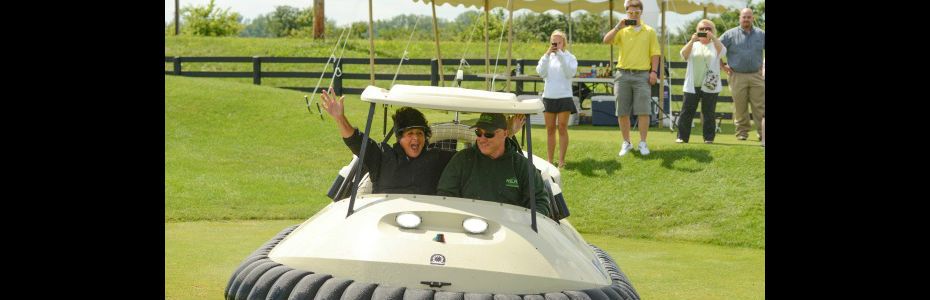
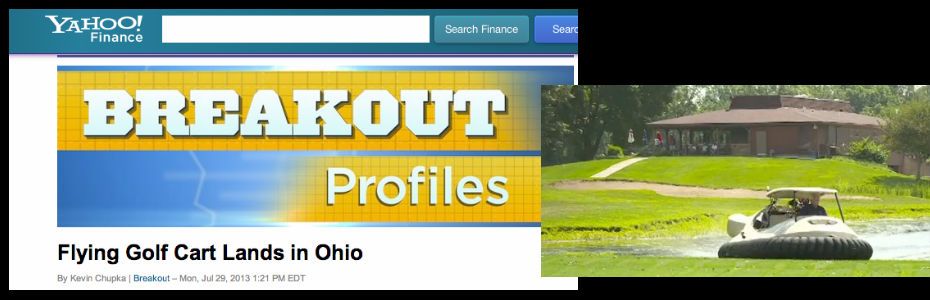
When Paul sold his sailboat last year, he and Janice were looking for a way to get back on the water, which they both love. He’d taken up golf, but discovered he was “terrible at it!” Ironically, he discovered hovercraft through golf in, of all places, a cigar shop. “I was having a cigar and reading a cigar aficionado magazine and there was an article about Bubba Watson and Neoteric’s hovercraft golf cart. So I decided ‘I’m gonna follow up on this!’”

Why a hovercraft? Again, it goes back to Paul’s love of decision-making. Before his HTC training course began, he explained, “Jet skis, for instance, are mindless. You get on and you just drive. For the first 15 to 20 minutes, they’re interesting; after that, they’re not. With sailing, as opposed to powerboats, you have to constantly be computing in your mind – the difference in the wind, sail trim, etc. I think hovercraft will probably be closer to sailing, in that you’ll need to make decisions based on wind forces, balance, trim and such. And I find that much more engaging. It keeps my interest, where on a jet ski you’re just going fast on the water. I always like to be challenged, to learn new things and be engaged. Hovercraft are much less ‘mindless’ than other things you can do on the water.”

 Janice adds, “The thing he’s not telling you is he likes to be unique and do things that nobody else around is doing!” 
Paul is about to learn how to ‘mindfully’ fly a hovercraft as Fitzgerald launches the craft onto the river
for his flight training session.
Paul and Janice also realized that, as an all-season vehicle, a hovercraft will expand the time they can spend outdoors. “In our climate a jet ski or sailboat is usable on Lake Erie only about three months of the year,” Paul explains. “I want to extend the season and a hovercraft will allow me to do that so I can go out in the fall and winter and when the bay freezes over on the lake I can zip across.”

During his day of flight training with HTC Senior Instructor Chris Fitzgerald, Paul learned some new and challenging things about making decisions. Overall, he said, “It was exhilarating, a wonderful experience! It’s not unlike sailing in a lot of ways, except it’s in two more dimensions, so you’re very involved as you fly the machine. And with the reverse thrust, the spins are every little boy’s dream! It’s phenomenal!”
Paul’s enjoyment of learning something new is apparent during his flight training.
 But he learned that the decisions you make in flying a hovercraft are a bit different than the decisions you make in operating other watercraft. “As a sailor you stay away from the shore, you stay away from floating objects. Chris took me into some very tight situations and a couple of times he was instructing me to steer into the shore and logs and debris and I wouldn’t; I told him ‘There’s something wrong with this!’”

Paul continues, “So we stopped and discussed my concern about getting close to obstacles and such because of my experience in sailing. Then we went into some very, very shallow areas, with large rocks and logs. The debris that a sailor or boater would steer clear of, we aimed for and flew right over it! We flew right OVER logs and debris! So it was counterintuitive in some ways.”
Even though at first Paul thought Fitzgerald “was a little crazy” to steer right into obstacles, he soon learned that flying a hovercraft is different than sailing a boat.
At the end of the day, Paul concluded that his HTC training course was a wise decision. “This was a good investment of time, there’s no question about it; it’s proven from every perspective. To venture out on a hovercraft without training would be craziness. The only way to go if you’re going to do this, and do it safely, is to get the training.”

Paul also observed that thorough training also increases the capabilities of your hovercraft. “If you’re going to spend the money for a hovercraft, training expands the use potential. Without it, you won’t get the full experience and will never fully understand the capabilities of the craft.  The things Chris taught me - by getting into some tight situations, flipping it around, doing some interesting things – if I were teaching myself, I never would have learned them. It was amazing what he did with the craft!”
Paul DiFuccia (left) accompanied by his wife Janice (right) earns his hovercraft pilot certification from HTC Senior Instructor Chris Fitzgerald (center).

Discover the amazing things you can do with a hovercraft: