
HTC trains not only rescue, commercial and recreational hovercraft
pilots, but military pilots as well – and this is a segment of our business
that may expand. HTC is exploring the possibility of the U.S. Navy using light
hovercraft for initial pilot training for LCACs (Landing Craft Air Cushion) and
the new generation of SSCs (Ship-to-Shore Connectors.)
Currently, LCAC Craftmasters are trained using simulators,
following by final training in actual LCACs; from what we are told this is a
costly protocol with low retention rates. According to information we gathered
from the Navy’s Virginia Beach hovercraft training base, it costs the military
approximately $200,000 per trainee. Each trainee spends approximately 100 hours
in simulators, which cost $800 per hour to operate. Trainer LCACs operate about
150 hours per year, which costs $7,800 per hour. And the current dropout rates
for Craftmasters, Engineers, Navigators, and Loadmasters ranges from 15% to
65%.
Last spring, HTC founder Chris Fitzgerald was invited to the U.S.
Navy Assault Craft Unit 4 in Virginia Beach, where half the Navy’s fleet of 72
LCACs are based. There, he visited with Craftmaster Trainers Andy Sutter and
Dave Convery to study and learn about the LCAC training protocol and to
determine if HTC could assist in improving the current program. He also had the
opportunity to operate a simulator and to pilot a 100-ton, $22 million LCAC -
with no previous training other than his experience piloting light hovercraft.
After his flight, Fitzgerald observed, “I
found it relatively easy, and that was with no advance instruction. I had no
trouble getting over the hump, operating in a straight line, turning,
modulating speed, stopping. I attribute that to my experience piloting smaller
light hovercraft; it was pretty much second nature.”
Fitzgerald’s visit to ACU4 confirmed his theory that light
hovercraft could benefit the Navy’s LCAC training program. In contrast to the
Navy’s protocol, military aircraft pilots are initially trained in light
aircraft, then move directly to heavy aircraft. Following this protocol and
using light hovercraft for initial LCAC/SSC training is likely to be a much
more efficient and cost-effective method.
As the next step in this exploratory mission, Craftmaster Trainers
Andy Sutter (now retired) and Dave Convery traveled to HTC headquarters to
undergo our Standard Training Course in order to judge and advise whether or
not light hovercraft could be applicable to heavy hovercraft training. First,
they underwent classroom and maintenance training, after which Convery
observed, “Compared to ours, light hovercraft are nothing
maintenance-wise.”
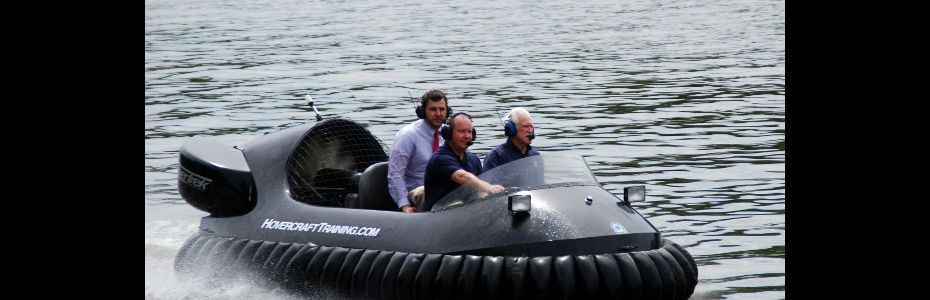
Here are a few photos from their training course …
Chris Fitzgerald (center)
leads Andy Sutter (left) and Dave
Convery (right) through a preflight
inspection on an HTC Neoteric training hovercraft …

With a thumbs-up, Sutter takes off on his first flight in a light
hovercraft, with Chris Fitzgerald at the controls …

Through wireless headsets, each Craftmaster listens to the other’s
entire flight training session. Here, Convery listens to Sutter’s flight …

Sutter takes the controls, while Fitzgerald provides constant feedback
and instruction …

The Neoteric Hovercraft’s reverse thrust system caught Sutter’s
attention even before his first launch: “I
was impressed when Chris spun the craft around and backed it up to the
trailer.” Here, he learns to operate it himself …

At the end of his flight training session, Sutter easily
transitions the craft from water to the boat ramp …

Dave Convery (left) and Andy Sutter (right) accept their HTC Pilot
Certifications from Chris Fitzgerald …

Both Craftmasters felt that their day of training was productive and
that it enabled them to experience the differences – and many similarities –
between light hovercraft and heavy military hovercraft. “I felt very comfortable; it’s very similar to what we teach. Before I
came here I was skeptical that flying this hovercraft could help anyone fly an
LCAC. But flying this craft, using the thrust buckets, it does help,”
Sutter said.
And Convery agreed, “The
training session was excellent. I really enjoyed it and I’m very enthusiastic
about what this craft does.” He added, “It’s
sensitive; I expected it to be a little more reactive, but not like this. When
you put the controls in, you are gone. In that regard, it’s the same as ours.
It’s like an air hockey puck. When you push an air hockey puck across the
table, it goes until it bounces off something. And that’s what’s going to
happen without this training.”
Sutter and Convery's visit solidified the premise that light hovercraft could play a role in the LCAC/SSC training program, and we'll keep you informed as this project moves forward. Should the U.S. Navy utilize Hovercraft Training Centers and Neoteric Hovercraft to streamline their training protocol, it would improve the cost/benefit ratio of training for the Department of Defense. It would also lower the high attrition rate by serving as an inexpensive way to qualify future Craftmasters and Navigators. And, since Neoteric Hovercraft easily capture public attention, they're an excellent public relations and marketing tool that would boost the success of the military's recruiting efforts.
Sutter and Convery's visit solidified the premise that light hovercraft could play a role in the LCAC/SSC training program, and we'll keep you informed as this project moves forward. Should the U.S. Navy utilize Hovercraft Training Centers and Neoteric Hovercraft to streamline their training protocol, it would improve the cost/benefit ratio of training for the Department of Defense. It would also lower the high attrition rate by serving as an inexpensive way to qualify future Craftmasters and Navigators. And, since Neoteric Hovercraft easily capture public attention, they're an excellent public relations and marketing tool that would boost the success of the military's recruiting efforts.
..........