Visit HovercraftTraining.com to learn how hovercraft can help you work smarter or play harder, check out our course offerings and sign up to begin your adventure in flight.
Showing posts with label Rescue hovercraft. Show all posts

23 January 2017

Firefighters / First Responders: See Hovercraft Training Centers & Neoteric Hovercraft at FDIC 2017

Hovercraft Training Centers and Neoteric Hovercraft will be featured at this year’s FDIC (Fire Department Instructor Conference). The world’s largest firefighter conference and expo - attended by 35,000+ firefighters, chiefs and instructors from more than 53 nations - takes place April 24-29 in Indianapolis at the Lucas Oil Stadium and Indiana Convention Center.

If your department still relies on ropes, boats and other apparatus for water, ice and mud rescues, you’ll definitely want to visit us at Booth #2704 and …

1) Watch videos of hovercraft rescue operations by HTC-trained pilots
2) Fly a remote-controlled hovercraft.
3) Get answers to all your questions about rescue hovercraft and pilot training.
4) Register to win one of three FREE Hovercraft Flight Training Courses, valued at $1,575 each!    


The Hovercraft Training Centers / Neoteric Hovercraft booth at last year's FDIC.
Flat bottom Jon boats and other watercraft are of questionable use in shallow water, swiftwater, flood, ice and mud rescues, and they can be seriously dangerous to you and to the lives you’re tasked to save. Come see how a Neoteric rescue hovercraft can greatly improve the safety, ease, speed and success of your rescue operations … while keeping you above the danger – not in it. It quickly flies you into areas where no other vehicle can go, and it’s the only hovercraft with the ability to brake and back up. 

But don’t just take our word for it. See what HTC-trained first responders around the world say about their Neoteric Hovercraft in comparison to other rescue vehicles …

Council Bluffs Fire Department, Iowa:


Central Fraser Valley Search & Rescue Society, Canada:
"The hovercraft gets us into areas that, before, we weren't able to reach, areas that our jet boat can't get into because we ingest debris into the impeller. And the hovercraft saves us a lot of time."

North Muskegon Fire Department, Michigan:
"Our hovercraft have saved more lives that all our fire engines combined. Since 1985, more than 255 people have been rescued from Muskegon area lakes using the hovercraft. More than half of them would have drowned not having the hovercraft as a safe rescue tool."

Mansfield Fire Department, Texas:
"The benefit of having the hovercraft is we do not have to send our personnel into the water to retrieve victims. It can also hover over logs, car tires and any other debris, unlike boats, that could be a hazard in the water. A hovercraft is the answer to a faster rescue - a safer rescue."

Davis County Sheriff's Office, Utah:
"Our hovercraft, without question, has saved lives. Much of our county is covered by the Great Salt Lake, and when the water is low it leaves miles of mudflats boats can't reach. We can't get airboats out there. When it's extremely windy it's hard to get an aircraft or helicopter out there, and even walking out is impossible. We were putting rescuers in harm's way, but the hovercraft allows us to hover over mud, ice or water and get right to the patient - to literally reach out our hand and pull them out."


Read more about Hovercraft Pilot Training ...

and

Learn more about Neoteric Hovercraft ...


13 September 2016

Pakistan Air Force discovers importance of hovercraft pilot training

In 2013, the Pakistan Air Force (PAF) Sea Survival School (SSS) purchased two 4-passenger Neoteric Rescue Hovercraft for security patrol along the Korangi Creek Air Force Base shoreline in Karachi, Pakistan. The curved shoreline contains mudflats and mangroves that make it inaccessible to vehicles other than hovercraft. 

One of the two Neoteric Rescue Hovercraft purchased by the Pakistan Air Force
Sea Survival School is shown here during preliminary testing on the
Wabash River in Terre Haute, IN.

At the time of purchase, the PAF’s budget did not allow for their hovercraft to be equipped for saltwater operation, or for flight training and maintenance instruction. Due to this lack of training – which includes teaching the additional maintenance procedures required when a hovercraft is not equipped for saltwater operation – both of the PAF’s hovercraft suffered deterioration.

Fortunately, both Hovercraft Training Centers and Neoteric Hovercraft, Inc. offer dedicated customer service. Chris Fitzgerald, HTC Senior Instructor and Neoteric President, traveled to Pakistan for a week to conduct maintenance instruction, to provide onsite flight training, and to assist in upgrading both Air Force hovercraft for saltwater operations.

The work was done at the PAF Sea Survival School, under the command of Squadron Leader Raza Khan, the Commanding Officer of the SSS. Wing Commander Mahmood traveled from Islamabad to review the training program. The following personnel were involved in the restoration of the two hovercraft: Squadron Leader Raza Khan; Senior Technician Mahid (electronics & weapons); Chief Technician Mairaj (ground transport engines); HS-1 Rashid (electrical); Skilled TM Wagar (student fitter); HS-2 Iqbal (painter); Skilled TM Najam (maintenance) and Chief Technician Farooq (road transportation driver).

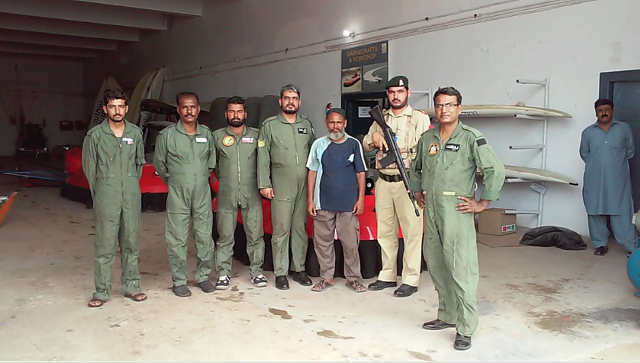
The Pakistan Air Force hovercraft maintenance crew and pilots pose for a photo in their workshop/storage facility. Left to right: Chief Tech Mairij, HS-2 Iqbal, HS-1 Rashid (electrical), Skilled TM Wagar, instructor Chris Fitzgerald, a security guard,
Skilled TM Najam and Senior Technician Majid.

Senior Technician Majid (left) and Chief Technician Mairij undergo maintenance training
while assisting in upgrading the two rescue hovercraft for saltwater operation.

The Pakistan Air Force Sea Survival School hovercraft team, from the left: Skilled TM Wagar, HS-1 Rashid, Skilled TM Najam, Senior Technician Majid, HS-2 Iqbal, 
Security Guard, Chief Technician Mairij, and a visitor on the far right.

The PAF Sea Survival School:
The primary role of the Pakistan Air Force Sea Survival School is to train fighter pilots in “survival at sea.” In addition to their two hovercraft, the SSS also operates several fleets of sailboats, windsurfing boards, motor launches, jet skis and inflatable dinghies for rescue missions, training and for the PAF’s participation in national and international competitions. In addition, Pakistan and surrounding nations rely heavily on the PAF for tsunami, cyclone, earthquake and flood rescue operations.

The Pakistan Air Force Sea Survival School in Karachi, Pakistan.

Chris Fitzgerald reports that the SSS has an excellent, wide and gently sloping concrete hoverway reaching out to the sea. During his visit, the prevailing 15 mph winds continually generated 1- to 2-foot waves. He says, “This was an outstanding team of dedicated and cheerful people who worked relentlessly under harsh conditions to restore both hovercraft in a limited time frame.

The importance of hovercraft training:
Due to the omission of flight and maintenance training when the Pakistan Air Force purchased their two hovercraft in 2013, the craft suffered enough damage that their refurbishment, and maintenance training to personnel, took longer than anticipated. This left insufficient time for flight training. Chris Fitzgerald was able to give preliminary pilot training only to Commander Raza and Chief Technician Mairij. But this can be rectified by additional flight training either onsite in Pakistan or at Hovercraft Training Centers in the U.S.

Make no mistake: a hovercraft is a flying machine. You don’t drive it - you fly it 9 inches above the surface. Just as you wouldn’t jump into a helicopter and take off without proper flight training, neither should you do so with a hovercraft.

Capt. Cory Lingelbach, a U.S. Air Force firefighter and hovercraft pilot at the Hill Air Force Base Utah Test & Training Range, explains the importance of training quite concisely: 

Trying to fly a hovercraft without training would be nuts! We use our hovercraft on and off our base. Without the level of training sophistication that Hovercraft Training Centers provided, we would never be able to perform our missions the way we do.

Capt. Cory Lingelbach (left) and his fellow U.S. Air Force personnel
went through flight training and maintenance instruction when they took
possession of their new rescue hovercraft at the Neoteric factory.

Capt. Lingelbach enrolled in Hovercraft Training Centers’ Advanced Training Course, which includes hard access, fast-flowing water rescue and nighttime operational training. For he and his team, learning how to operate a hovercraft properly has not only proven to boost the safety of their rescues, but it has also dramatically improved their response times. The UTTR Air Force rescue team has reduced its recovery time from an average of two hours with ATVs to just 20 minutes with hovercraft.


Military personnel and first responders: 
Learn how a Neoteric Hovercraft gives you faster, safer rescues ...

Then take a Test Flight to see for yourselves.


28 June 2015

VIDEOS: The Lighter Side of Hovercraft Training

If you think learning to fly a hovercraft – especially a rescue hovercraft – is all work and no play, just check out these videos!

HTC flight instructor Steve Stafford is also the founder of Project H.E.R.O., Inc. (Hovercraft Emergency Response Operations), a non-profit group of rescue professionals who deploy hovercraft in disasters and assist police and rescue agencies. Steve often organizes informal rescue practice sessions with first responders to keep their skills honed.

Recently he held such a practice session with Indiana’s Washington Township Fire Department and White River Hazelton Fire Department. Yes, they worked hard, but when training time ended, playtime began! Watch as they take campers on joyrides in their Neoteric rescue hovercraft … and run over each other with Stafford’s hovercraft ...


And yes, he really did get run over by the hovercraft – here’s the proof ...


Just goes to show you how safe a hovercraft really is. Want to find out for yourself?

Sign up today for a Test Flight or Training Course

(NOTE: Getting run over is not required.)


12 December 2014

VIDEO: Hovercraft Pilot Training in Vietnam

Early this year, Hovercraft Training Centers' Senior Instructor Chris Fitzgerald traveled to Hanoi to train first responders from Vietnam's National Department of Rescue & Relief, as well as personnel from Tuyet Nga Co. Ltd., a security and rescue equipment supplier. Tuyet Nga purchased two Neoteric rescue hovercraft for use by the National Department of Rescue & Relief - a great asset in a nation so often plagued by monsoons and floods.

In this recent video, you can see the value of being trained by HTC to train other hovercraft pilots. Here, the HTC-trained pilots are conducting flight training in Vietnam for first responders from Brigade 249 of the Public Affairs Command, who will use the hovercraft for search & rescue and military operations ...


Join the global ranks of HTC-trained hovercraft pilots ...

21 November 2014

An Uncommonly Practical but Fun Holiday Gift: Hovercraft Flight

No matter what your occupation, it’s that time of year when you start thinking about the holidays, and about what gifts you’d like to give – or receive! Recently Clay Russell of Richmond, Kentucky, gave himself an uncommonly practical gift that you might want to give someone on your Christmas shopping list – or add to your own “wish list”.

Clay owns a security systems company in Richmond, and has been a volunteer first responder for most of his life. “I joined the fire department when I was just 15 years old, and started driving the truck when I was 21,” he said. “I got out of firefighting some time ago, but I still volunteer with the rescue squad. I’m a little older now, and not as active as I’d like to be. I pretty much work all the time, trying to build up that retirement fund, so I don't have a lot of hobbies.

Sound familiar? Maybe, like Clay, you or someone on your holiday shopping list needs a break! He decided to mix business with pleasure by taking a Flight Training Course at Hovercraft Training Centers. “I haven’t really had a vacation in a long time by myself, and I needed a diversion,” he laughed. “I guess that’s a big reason I’m here today. But all my diversions have some sort of either business or altruistic motives; I can’t just go recreate by myself. I needed a reason, so I picked this.
Clay Russell (left) receives his Hovercraft Pilot Certification from HTC Senior Flight Instructor Chris Fitzgerald.
Everyone would agree that learning to fly a hovercraft is fun, but how do business and altruism fit into Clay’s motives? “What I need to do today is become as familiar as I can with a hovercraft and take this information back to my department – and to my family – and then convince them to either purchase one or help me purchase one,” he explained. “If we buy a hovercraft, I would own it personally and my department could use it for rescue purposes. After a few years, when I retire, maybe I’ll take it to Florida and start a tourism business, I don’t know. Hopefully I can retire with it and have fun!”

Clay describes why his department needs a hovercraft: “The lakes in our area partially freeze over in the winter, then people walk out onto the ice and, of course, they end up needing to be rescued. And in the summer, we have some swiftwater in the area. The Kentucky River, albeit not swiftwater, has dams, so there’s also choppy water we deal with. We normally use a Zodiac for rescue, but it’s very hard to operate. We need something that will stay stationary in moving water.

And a hovercraft comes naturally to his family’s outdoor lifestyle. “I do rock climb and hike a little bit, with my 8-year-old daughter. My whole family’s kind of outdoorsy,” Clay said. “And not only is a hovercraft an outdoor vehicle, it’s more technical. As a kind of amateur mechanical engineer, it’s very interesting to see how they work. And they’re not common; I’m into the uncommon things in life.

Clay also came to Hovercraft Training Centers because we train exclusively on Neoteric hovercraft. “I’ve known about hovercraft for years, and I’ve researched every brand out there. I was most impressed by the Neoteric HoverTrek's reverse thrust. So that’s another reason why I’m here.”
With Senior Flight Instructor Chris Fitzgerald providing guidance,
Clay Russell experiences the thrill of flying a hovercraft for the first time.
Who in your life needs a break? Maybe someone who has considered a hovercraft for work or play and would love to do a feasibility study that’s actually fun? (If this describes you, start hinting now!) Shirts and ties have their place, but there’s no better stocking stuffer than the gift of hovercraft flight. And it lets you completely avoid the Black Friday rush!

The most unique holiday gift you can give – or receive … 


19 March 2014

Dan Brown: “If you don’t train, you’re taking your life into your own hands.”

Dan Brown, an optometrist from Olney, IL, had owned a Hovertechnics hovercraft for 15 years – but he rarely used it. “I had no training; I just read the manual and I wasn’t that confident in it. I probably flew it only 5 hours or so over the years.”

The craft’s previous owner was also untrained. “He had a bad experience with it,” explains Dan. “With no training, he just jumped in the darn thing and took off. He was out duck hunting and got thrown out of it because he didn’t really know how to run it. It scared the you-know-what out of him so he got rid of it.

So when Dan decided to trade his Hovertechnics craft in on a new Neoteric HoverTrek, he took an HTC training course on the day he picked up his craft. Here, with his new hovercraft and wearing a pleased smile, Dan (right) accepts his pilot certification from HTC Senior Instructor Chris Fitzgerald …

When Dan decided he wanted “something new to play with”, he chose a Neoteric craft for one of the same reasons we use them exclusively at HTC. “I got on the Internet and read about Neoteric’s reverse thrust buckets – and that’s the ticket, right there. That’s what sold me. No other hovercraft can do that!

Watch Dan’s Wabash River flight training session begin last Sunday, a cold and blustery day …

But at HTC, you don’t “just jump in the darn thing and take off.” First, you go through classroom training, covering hovercraft function, operation, and maintenance. Then, as pilot training begins, the instruction continues. First, Dan learned how to easily unload his hovercraft from its trailer …

Then, Chris Fitzgerald took him through a thorough preflight inspection …

Next, Dan learned how to fuel his hovercraft …

Before launching onto the river, both Dan and Chris donned wireless headsets so Dan could receive constant instruction and feedback while he learned to fly his hovercraft …

How did Dan feel after his cold but extensive day of training? “I feel like I got frostbite! But training is definitely important, there’s no question. I really learned a lot in the classroom session. I didn’t realize there was so much that went into it, and I understand it a lot more now. Great day!”  Then he added, “If you don’t train, you’re taking your life into your own hands. Just like the guy I bought the Hovertechnics from – he didn’t have any training, and he ended up getting thrown out of it. If he’d been trained, it wouldn’t have happened.

Training on such a cold day was good practice for Dan, a waterfowl hunter, because he'll be using his new hovercraft primarily in winter. “I live on East Fork Lake, and when it’s frozen over I have trouble getting to places, to my duck blinds. In summer, there are boats everywhere, bass tournaments, water skiers, Sea-Doos – it’s just crazy. In winter, I’ll have the lake to myself. That’s the main thing – I want to be able to get out there when no one else can.

And Dan may also be performing rescues. In 2010, he made headlines by using his Hovertechnics craft to rescue his neighbors’ two border collies when they fell through the ice on East Fork Lake. The Olney Fire Department and nearly 300 people had gathered to save the dogs. Dan relates, “The owner was out on a ladder, trying to grab the dogs with extension cords tied together and the firemen were telling him to get out of the icy water. Another person trying to help also fell through the ice. The dogs were just hanging there; they had the look of death in their eyes. The owner and I flew the hovercraft right up to them, grabbed them out of the water and hovered back right into his yard where he carried them into his house and started thawing them out in a hot bath.”

After that, the fire department asked Dan for his phone number, “so if we need you we can call you.” He may start getting those calls now that he owns a Neoteric hovercraft, known for its rescue capabilities and used by first responders across the world.

But whether its used for recreation or rescue, thanks to his training at HTC, Dan’s new hovercraft won’t just sit in his yard unused for years. “I’ll get out in this new one more,” he says, “I’ll be much more confident with it.”


Whether for rescue or recreation, find out if a hovercraft is right for you;


07 February 2014

First responders: Is a hovercraft right for you?

There’s no better way for first responders to determine if a hovercraft will suit their rescue needs than to undergo a training course at HTC – just like Chris Kleppe and Sean Geib.

Chris (Supervisor) and Sean (Assistant Supervisor) are in charge of the University of Wisconsin Lifesaving Station in Madison. Established in 1909 on 10,000-acre Lake Mendota, the Station is a safety and rescue operation for both the University and the city of Madison. 

Sean Geib (left) and Chris Kleppe (right) receive their Hovercraft Pilot & Maintenance Certifications
from HTC Senior Instructor Chris Fitzgerald.
But, as Chris explains, “We have no ice rescue capabilities at the Lifesaving Station – none whatsoever. We need to have some way to get out there to someone who might be in trouble – especially the ice fishermen because they have to travel across unsafe ice to get to the safe ice to fish. ATVs won’t do that. Once we saw a fisherman out on a hovercraft - okay, the light went on.

Sean adds, “And you’d be surprised how many people will walk out onto unsafe ice. Close to the lake is the University with more than 40,000 students from all over the world. Some of them are familiar with ice, but many aren’t, so they do high-risk things we just can’t believe. And with global warming, we’re getting more and more days of thin ice and more risk.”

The pair describes why they decided to undergo training before buying a hovercraft: “The more training you have, the better you’re equipped to help someone out in emergency situations where your adrenaline is running high. We both also understood that a hovercraft is not a boat; this is something completely outside our realm of knowledge, so we decided it would be both advantageous and fun to get the training.

And we’re here to have some questions answered, too,” explains Sean, “Not only from the operational standpoint but to see if it will be compatible with our facility, since we have no flat spaces and no ramps.

Fittingly, Chris and Sean’s training on a frigid January day showed them exactly how a hovercraft operates on ice. Check out the photos of their flight training session below, then read what they had to say after completing their training course …

After a morning of classroom instruction, Chris Kleppe learns how
to fuel the hovercraft at the Wabash River training site.
Next, Sean inspects the skirts as they learn to conduct a thorough preflight inspection.
With HTC instructor Chris Fitzgerald at the controls, Chris Kleppe is ready to launch
on the partially-frozen river for his first flight instruction session.
Now behind the controls, Chris Kleppe sees first-hand why a hovercraft is the only vehicle
able to travel safely and easily over thin or broken ice.
Now Chris learns how to fly the craft over water.
During their flight training sessions, both Chris (piloting the craft) and Sean (waiting back on shore for his session) receive constant feedback and instruction from their HTC instructor via wireless headsets.
After returning to Wisconsin, HTC received the following email from Chris Kleppe describing their training experience:

We both felt the training was very important. Floating on air is the best way to describe how it felt to me. Certainly the feeling was completely different than any other vehicles that I have piloted. Most surprising was the need to think way ahead of any maneuver that was made. Without the training, I could foresee a future disaster by way of a crash. To anyone trying to pilot the craft with no training I would say, ‘DO NOT DO IT.’ Plain and simple.

The hovercraft would be a useful tool for the Lifesaving Station during the freeze up and thaw out of the lake when the risk of someone going through the unsafe ice is very high. To perform winter lake safety work on Lake Mendota, I feel the hovercraft would be essential.”


11 September 2013

Walt Sitz, Eagle Wings, Inc. – A Man on a Mission

Walt Sitz is a man on a mission – and he’s making a hovercraft part of that mission.  He signed up for training at HTC before his hovercraft purchase. “Training should be the first step in any vehicle. You don’t just jump in a plane and say ‘I think I can figure it out.’ If you can’t, the alternatives are not good!”

His wife Pat, who listened to Walt's entire flight training via wireless headsets, adds, “It’s like flying an airplane; you have to fly so many hours before you can solo, and can’t get a license until you’ve done 40 hours.

They should know: Walt has been in the aviation business for 25 years – from piloting planes to aircraft maintenance and repair to marketing powered parachutes and more. “I was raised on a ranch, and when a plane would fly over, I always said ‘That’s what I want to do,’” he explains. “It’s in my blood.”

Even though he’s one of those lucky people who’ve turned their hobbies into their life’s work, Walt doesn’t see recreational vehicles as just for pleasure. He says, “From way back I’ve always first thought, ‘How can it be used to help people.’ Boats, parachutes, snowmobiles, motorcycles, four wheelers – they can all be used to help people.

His company, Eagle Wings, Inc. in Burns, Oregon, is affiliated with Crisis Response International, a non-profit organization that provides rescue and relief support to humanitarian missions worldwide. Walt explains what sparked his interest in hovercraft: “I deployed to New York for Hurricane Sandy – loaded our Forest Ranger with all my tools and equipment and used it to set up a base camp. You can try to row a boat through the flood debris, but if I could deploy with a hovercraft, that’s what would be used. It’s a natural addition.”

After thorough classroom training, Walt began his flight training with a complete preflight inspection, guided by HTC chief instructor Chris Fitzgerald ...

With  a thumbs-up, the training craft is launched onto the Wabash River, where Walt will soon take over the controls. His positive attitude serves him well - as his wife Pat describes him, "Don't tell him he can't, because he can!" ...

And he did! His day at HTC boosted Walt's "can-do" confidence: "We got into one spot that you could never get into with a boat or anything else, and we turned around right in this tree with barely enough room for the craft and the current running fast through the tree. You could have rescued someone off that tree. That showed me right there what a hovercraft can do. It was pretty unbelievable!"

After a productive training day, Walt receives his pilot certification from Chris Fitzgerald ...

Now on to his next mission: with his natural mechanical bent, Walt has chosen to build his own hovercraft from a Neoteric Partially-Assembled Hovercraft Kit.